

For many Australian business owners, cyber insurance still sounds optional until they see the true cost of an incident. In 2024-25, the Australian Cyber Security Centre handled more than 42,500 hotline calls, and the average self-reported cost of cybercrime was A$56,600 for small businesses and A$97,200 for medium businesses, according to the Insurance Council of Australia's cyber risk overview. That's not an abstract IT problem. It's payroll, downtime, client disruption, legal stress, and months of cleanup.
That's why cyber insurance in Australia has shifted from niche cover to a practical business continuity tool. The policy matters, but the businesses that get the best value from it are usually the ones that treat insurance as one layer in a broader risk plan. They harden Microsoft 365, lock down admin access, test backups, know their vendors, and can show an insurer they're not guessing about security.
Table of Contents
- The Uninsurable Risk That Became Essential
- What Cyber Insurance Actually Covers
- Common Exclusions the Fine Print Hides
- Your Legal Duties Under Australian Data Breach Laws
- How Insurers Price Your Risk and What SMBs Can Pay
- How Your IT Partner Reduces Premiums and Prevents Claims
- Your Actionable Checklist for Getting Cyber Insurance Ready
The Uninsurable Risk That Became Essential
Cyber incidents are no longer edge cases for Australian businesses. They show up in ordinary work. Email compromise, stolen Microsoft 365 credentials, exposed remote access, a supplier breach that spreads to your systems. That is why cyber insurance shifted from a niche product to a practical part of business continuity planning.
In the early years, many owners and even some advisers treated cyber risk as too unpredictable to insure properly. The market changed because losses became easier to recognise in business terms. Downtime costs money. Forensic work costs money. Legal advice, customer notification, recovery support, and lost trading time all hit cashflow fast. Once those costs became repeatable, insurers could price them, and businesses had a reason to buy cover.
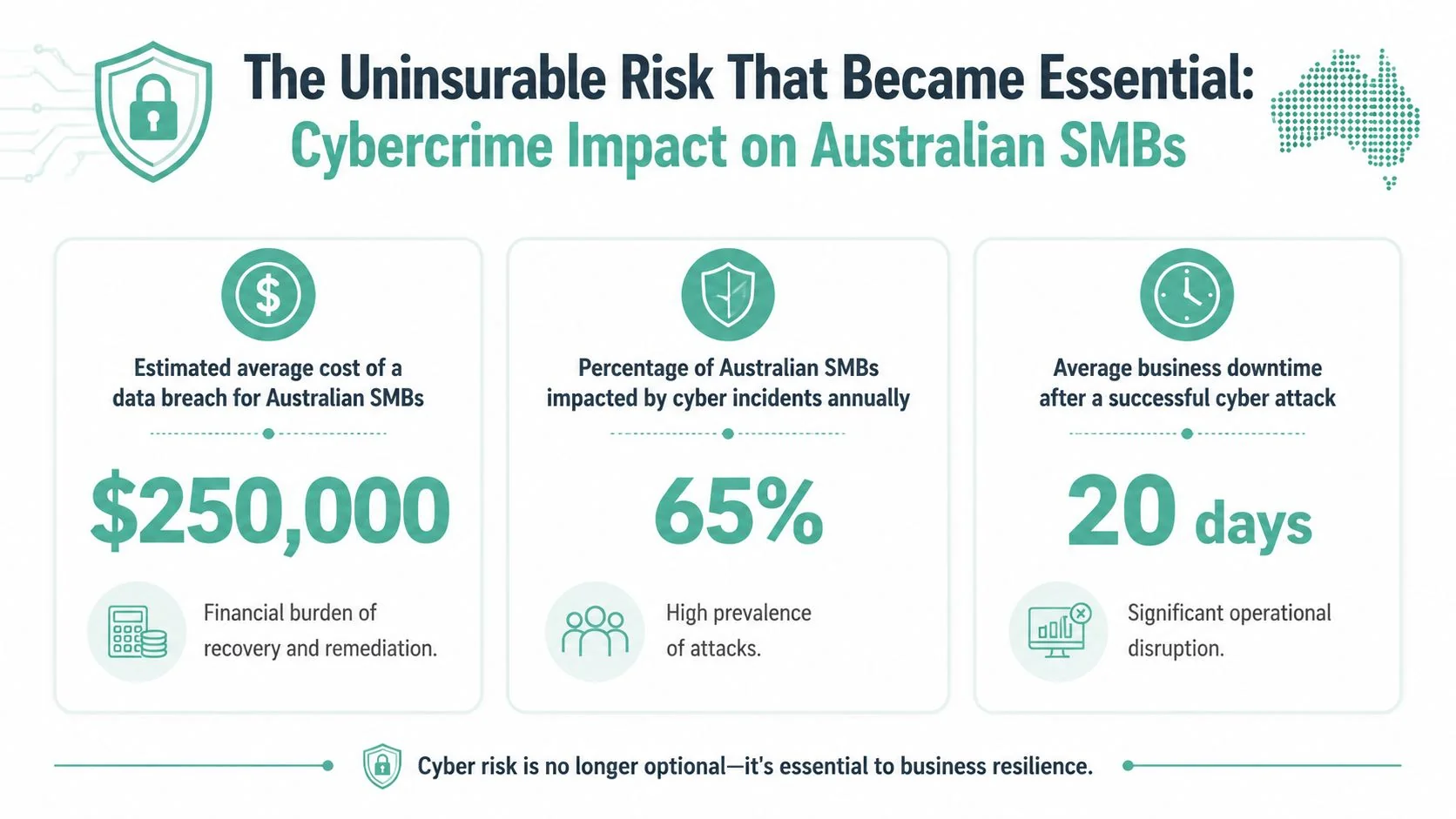
The practical point is simple. A cyber event is rarely just an IT problem. It interrupts sales, payroll, client service, and compliance work at the same time. For smaller firms, the main exposure is often the first 24 to 72 hours, when the business is trying to contain the incident, work out what happened, and keep operating.
That is also where many policyholders get caught. Buying cover does not mean the business is ready to use it well. Insurers expect basic controls, clear records, and a disciplined response when something goes wrong. We see this after incidents all the time. The firms that recover faster usually have both pieces in place: a policy that fits their risk and an IT setup that stands up under pressure.
Practical rule: If your business depends on email, cloud platforms, online banking, remote access, or customer data, cyber risk already sits in your day-to-day operating risk.
For Brisbane and South East Queensland businesses, local breach patterns matter because they show how often ordinary organisations get pulled into incidents through routine systems and suppliers. This review of data breaches in Australia gives useful context before you compare policies.
What Cyber Insurance Actually Covers
Cyber insurance in Australia is usually split into two buckets: first-party cover for your own losses, and third-party cover for the costs that arise when other people are affected by your incident.
That distinction matters in practice because a cyber event rarely creates just one bill. You may need forensic help, legal advice, system restoration, staff overtime, customer notifications, and a plan to keep trading while key systems are offline. Good cover is meant to fund parts of that response. It does not remove the need to respond well.
First-party cover pays for your own recovery
First-party cover applies to the direct impact on your business after a cyber incident. This is the part owners usually expect to need first, because it deals with the immediate cost of containment, investigation, and getting operations running again.
A practical view looks like this:
| Coverage Type | What It Pays For | Example Scenario for an SMB |
|---|---|---|
| First-party | Incident response, forensic investigation, data restoration, business interruption, extortion response, crisis support | A staff member clicks a phishing email, attackers lock systems, and the business needs forensic help, restored backups, and support while operations are disrupted |
| Third-party | Legal defence, privacy response, claims from affected parties, regulatory response costs | A firm loses client information and has to respond to complaints, investigations, and legal costs tied to the breach |
In real incidents, first-party costs often start before the business fully understands what happened. The insurer may approve forensic investigators, breach coaches, negotiators, or recovery specialists. Business interruption can also be part of the claim, but only if the policy wording matches the way your business loses income.
That last point is often missed. A retailer that cannot process payments has a different exposure from a professional services firm locked out of Microsoft 365, and both look different again from a medical practice dealing with unavailable patient records.
Third-party cover responds to the fallout beyond your own systems
Third-party cover deals with your obligations to clients, patients, suppliers, regulators, and other affected parties. If personal information is exposed, a contracted service is interrupted, or a complaint turns into legal action, this side of the policy becomes just as important as the technical recovery.
Common third-party costs can include legal defence, privacy advice, notification expenses, and the cost of responding to regulatory investigations or claims from affected customers.
For many small and mid-sized businesses, policy wording necessitates a close read. Some businesses focus heavily on ransomware and overlook the exposure created by email compromise, accidental disclosure, or a vendor-linked breach that affects customer data. We deal with the aftermath of these incidents regularly. The insurance question is rarely just "was there an attack?" It is also "who was affected, what duties were triggered, and how quickly can you prove what happened?"
Cover is only useful if it matches the way you operate
A good policy should reflect the systems your business relies on day to day. If your biggest risk is payroll disruption, cloud file corruption, point-of-sale outage, or fraudulent transfer after a compromised mailbox, test the wording against those scenarios before you buy.
Insurance also works better when it sits alongside a documented recovery process. If the business has not mapped critical systems, recovery priorities, acceptable downtime, and decision-makers, the claim may still help with cost, but the operational damage can drag on. A practical business continuity planning approach closes that gap.
The useful question is not whether a policy looks broad on paper. It is whether it would respond to the incidents your business is likely to have, and whether your systems and records would stand up when the insurer starts asking questions.
Common Exclusions the Fine Print Hides
The sales conversation usually focuses on what's covered. The claim conversation often turns on what wasn't maintained, what wasn't disclosed, or what the policy defines more narrowly than the business expected.
That's why cyber insurance should never be treated as a “buy it and forget it” product.
Security promises matter
Insurers increasingly expect the controls listed in the application to stay in place. If the form says multi-factor authentication is enforced for remote access or admin accounts, and the control was not active when the incident happened, you've created a claim problem before the forensic work has even finished.
Common trouble spots include:
- MFA not consistently enforced: One exempt mailbox, one legacy remote access method, or one unmanaged admin account can become the whole incident.
- Backups that exist but aren't usable: Backups that were never tested, were reachable from the production environment, or can't restore key systems quickly enough often create disputes around avoidable loss.
- Outdated answers on renewal forms: Businesses change software, staff, vendors, and workflows. If the paperwork doesn't change with them, the insurer may question whether the risk was properly disclosed.
Reality check: The policy is a financial backstop, not permission to run weak controls.
Definitions can decide the claim
Some losses fall into awkward grey areas. “Betterment” is one example. If you replace an old, insecure setup with a significantly improved platform after an incident, the insurer may only pay for restoration to the prior state, not for your full upgrade project.
Reputational damage is another area owners often misunderstand. Policies may pay for parts of crisis response, but they rarely compensate for lost trust in any broad or open-ended way.
The harder issue for modern SMEs is ecosystem language. Many businesses now run on Microsoft 365, Xero, hosted line-of-business apps, outsourced IT support, cloud backups, and third-party payroll or practice systems. If a loss is tied to a supplier, affiliate, subcontractor, MSP, or cloud platform, coverage can turn on narrow definitions such as whether the affected systems were “owned,” “operated,” “licensed,” or “controlled” by the insured.
That's not legal trivia. It can decide whether a SaaS outage, compromised vendor account, or outsourced admin error sits inside cover or outside it.
Your Legal Duties Under Australian Data Breach Laws
Data breach law turns a technical incident into a business decision under time pressure. Once personal information may be involved, the job expands fast. You need to contain the incident, preserve evidence, work out what data was exposed, assess likely harm, and record why you made each decision.
For many Australian businesses, the key legal trigger is the Notifiable Data Breaches scheme under the Privacy Act. If an eligible data breach is likely to result in serious harm, the organisation may need to notify the Office of the Australian Information Commissioner and affected individuals. Insurance can help pay for parts of that response. It does not take the obligation off the business.
That distinction matters in the first 24 to 72 hours.
The practical problem I see after incidents is not confusion about the law itself. It is the lack of groundwork needed to answer basic questions quickly. Which systems held personal information? Was the attacker in email, file storage, line-of-business software, or all three? Was the data encrypted? Do the logs show access, exfiltration, or just failed attempts? Without those answers, legal advice stays tentative and insurer-approved responders lose time.
A policy can fund breach coaches, forensic investigators, privacy lawyers, notification support, and crisis communications if those costs are covered by the wording. The stronger value, in practice, is coordination. Good incident response vendors know what evidence insurers want preserved, what privacy counsel needs to assess notification duties, and what sequence avoids creating avoidable disputes later.
Businesses that handle this well usually have three things in place before anything goes wrong:
- A current data map showing where customer, patient, employee, and supplier information sits.
- A clear escalation path so technical containment, legal review, and executive approval happen in the right order.
- Retained logs and access records that let investigators reconstruct user activity, privilege changes, remote access, and data movement.
These are not paperwork exercises. They are the controls that make legal response possible.
If you cannot quickly identify what personal information sits in which systems, both notification decisions and insurance response slow down.
There is also a trade-off owners should understand. Fast notification can reduce downstream harm, but notifying too early with weak facts can create confusion, extra cost, and statements you later need to correct. Waiting too long carries its own risk. The right move is usually disciplined fact-finding at speed, with legal input and forensic evidence guiding each step.
This is why cyber insurance should be treated as part of incident readiness, not just a finance product. The businesses that get through breaches with less damage usually did the operational work first. They knew where their sensitive data lived, who had access to it, how to preserve evidence, and how to reach the insurer's response panel immediately.
How Insurers Price Your Risk and What SMBs Can Pay
A single weak control can change the insurer's view of your business faster than a long list of good intentions. In practice, pricing often turns on whether an underwriter sees a business that can contain a common attack or one that is likely to turn a routine compromise into a costly claim.
Underwriters price the chance of a claim, and the cost of cleaning it up
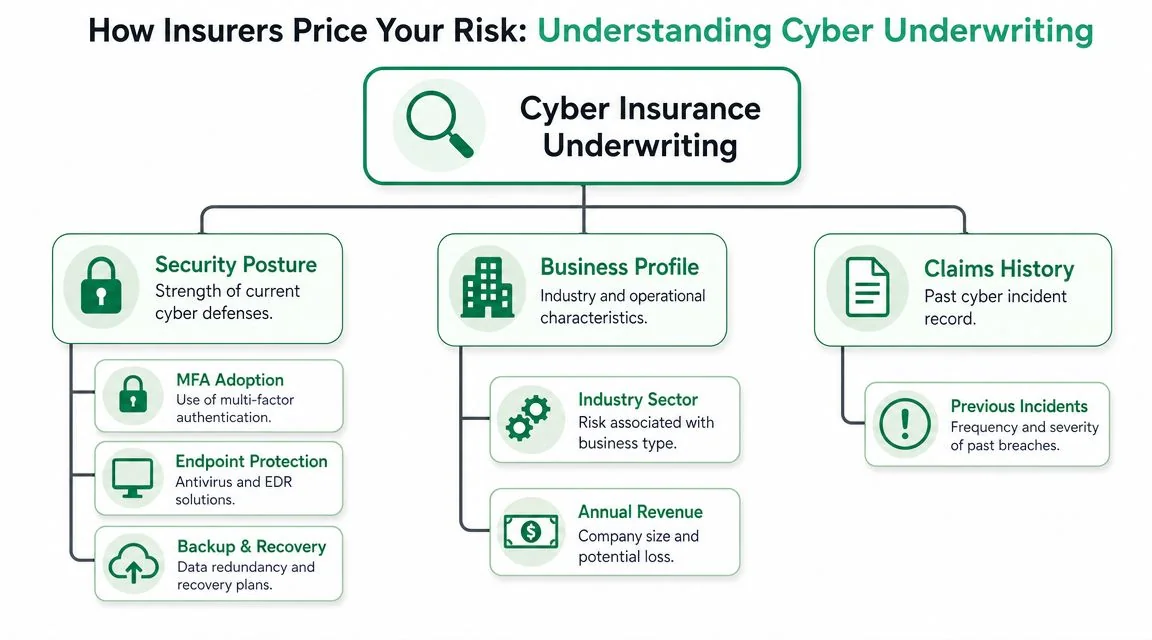
Revenue and industry still matter. So do the amount of sensitive data you hold, your reliance on email, remote access, cloud platforms, and outside vendors. But for many SMBs, the sharper pricing differences come from day-to-day security controls.
Two businesses can look similar on paper and receive very different terms. One can show enforced MFA, tested backups, managed devices, limited admin access, and a clear process for onboarding and offboarding staff. The other has shared accounts, old laptops outside patching, broad admin rights, and backup reports nobody checks. The second business is more expensive to insure because it is more expensive to recover.
That is the actual trade-off. Insurers are not only judging whether you might be breached. They are judging how messy, prolonged, and costly the incident is likely to become.
What underwriters usually examine
Applications and follow-up questions usually focus on whether key controls are operating and whether you can prove it. Common areas include:
- Identity security: MFA on Microsoft 365, remote access, administrator accounts, and payment approval workflows.
- Endpoint management: Business-grade endpoint protection, patching discipline, device monitoring, and coverage across laptops, desktops, and servers.
- Backup and recovery: Off-site or isolated backups, successful job reporting, restore testing, and realistic recovery time expectations.
- Email risk: Phishing controls, mailbox protections, domain security settings, and staff training for invoice fraud and credential theft.
- Access discipline: Joiner, mover, leaver processes, privileged access reviews, and controls over third-party access.
- Supplier exposure: A practical review of who can reach your systems or data, especially if you use outsourced platforms or IT providers. It also helps to understand vendor vulnerabilities before an insurer asks how those dependencies are managed.
A business with ordinary tools and consistent execution often presents better than a business that bought premium software and never configured it properly.
What SMBs can pay
There is no honest flat answer. Premiums shift based on your limit, excess, industry, claims history, data profile, revenue, outsourced dependencies, and the maturity of your controls.
The better question is what makes pricing move up or down.
Pricing usually gets worse when insurers see uncertainty. Examples include incomplete answers on the proposal form, weak MFA coverage, poor backup evidence, unmanaged devices, unresolved legacy systems, or broad administrator access. Pricing usually improves when the business can show that its controls are in place, reviewed, and supported by records.
From an IT operations perspective, preparation changes the outcome. A proper security baseline, such as the controls described in managed IT services that improve small business cybersecurity, gives insurers fewer reasons to load the premium or restrict cover.
The practical way to approach underwriting
Treat the insurance application as a technical review, not an admin form. If finance fills it out alone, answers often sound cleaner than the systems really are. That creates risk at claim time.
The safer approach is to have your IT partner, internal technical lead, and broker review the application together. Confirm which controls are enforced, which are only planned, and which still depend on manual workarounds. If a control is missing, disclose it accurately and show the remediation date. Underwriters do not expect perfection. They do react badly to surprises.
Businesses usually get better outcomes when they present evidence clearly, answer narrowly, and fix the obvious gaps before going to market.
How Your IT Partner Reduces Premiums and Prevents Claims
The businesses that move through cyber insurance smoothly usually have an IT partner who can answer the insurer's questions with evidence, not guesswork. That changes both the application process and the claim outcome.

Good IT support improves both placement and outcomes
An insurer wants to know whether your controls are operating. A capable IT partner can usually show that through policy settings, audit records, backup reports, device compliance, and documented response processes.
In practice, that means help with things like:
- Microsoft 365 hardening: Enforcing MFA, removing risky legacy access, tightening admin roles, and reviewing mailbox security.
- Endpoint security management: Deploying and monitoring endpoint protection across laptops, desktops, and servers.
- Backup verification: Checking that backup jobs complete, retention is sensible, and restores function correctly.
- Security awareness: Running phishing education and reducing the chance of invoice fraud or credential theft.
- Incident response support: Containment, evidence preservation, insurer notification support, and coordination with legal or forensic teams.
For businesses in Queensland, one local option is managed cybersecurity support for small businesses, which covers the kind of operational measures insurers increasingly ask about.
Third-party risk is where many SMEs get caught
A key gap in many policies involves incidents tied to a third-party vendor or MSP. Coverage disputes often arise from wording around whether systems are “owned” or “controlled,” which is especially relevant for businesses using cloud platforms and outsourced support, as explained in this Australian cyber insurance guide focused on policy wording gaps.
That's why a good IT partner doesn't just secure your devices. They help map the external services your business depends on. That includes cloud file platforms, line-of-business apps, payroll systems, website hosting, remote support tools, and payment workflows.
If you're trying to strengthen that side of your risk profile, it's worth learning how to understand vendor vulnerabilities before renewal time. Vendors often create the biggest blind spot between “we thought we were covered” and “the wording says otherwise”.
A strong IT partner helps close that gap by documenting who administers what, where data sits, which accounts are privileged, and how third-party access is approved and reviewed. That's useful before a claim, during a claim, and when you're comparing policies that appear similar on the front page but differ materially in the definitions.
Your Actionable Checklist for Getting Cyber Insurance Ready
Most businesses shouldn't start with quotes. They should start with readiness. That gives you a better chance of getting suitable cover and a much better chance of surviving the event the policy is meant to fund.
Pre-application checklist
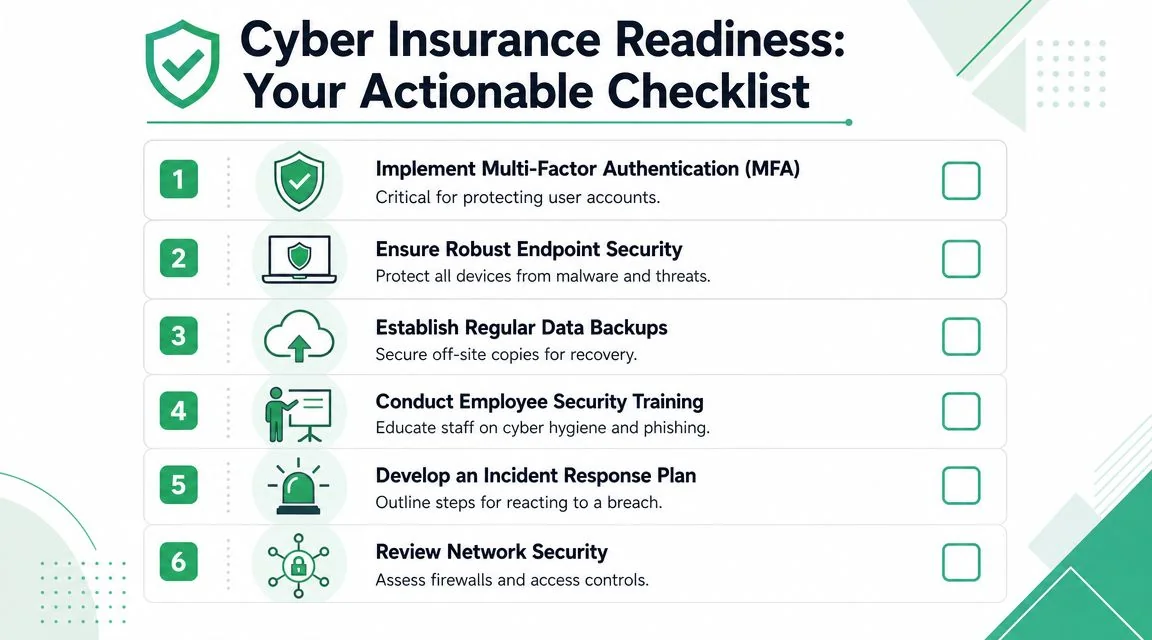
Use this as a working list before you speak with a broker or insurer:
- Lock down identity first: Turn on MFA wherever it matters most, especially Microsoft 365, admin accounts, remote access, finance approvals, and password resets.
- Check endpoint coverage: Make sure every business device has managed protection and a clear patching process.
- Review backups properly: Confirm backups are running, retained, protected from routine admin compromise, and tested through actual restores.
- Map critical systems: Identify the platforms that would hurt most if unavailable, corrupted, or locked.
- Document your vendors: List cloud providers, outsourced IT, payroll, accounting platforms, website hosts, and any party with privileged access.
- Train staff on high-risk scenarios: Focus on phishing, payment redirection, fake invoices, and unusual login prompts.
This short video gives a helpful overview of the preparation mindset many businesses need before applying for cover.
What to prepare before a claim ever happens
Don't stop at technical controls. Get the operational side ready too.
- Choose a broker who understands cyber wording. Generic commercial cover experience isn't always enough.
- Read the application with your IT lead beside you. The worst answers are confident but inaccurate ones.
- Ask how claims are triggered. Know who to call first and what evidence the insurer expects.
- Store key contacts offline. Include your broker, insurer, IT partner, legal adviser, and internal decision-makers.
- Review the policy against your real-world stack. Cloud services, outsourced support, and shared platforms should be tested against the wording, not assumed.
- Revisit the policy after major IT changes. New vendors, acquisitions, remote work shifts, and platform migrations all affect risk.
Good cyber insurance in Australia starts before the policy starts. It begins with controls you can prove and response steps your team can follow under pressure.
If your business wants to get insurance-ready before renewal or first-time placement, Bridge IT Solutions can help with the practical side: security baselines, Microsoft 365 hardening, backup review, endpoint protection, and the technical evidence insurers often ask for during underwriting.
