


You're probably looking for help because something has already gone wrong, or you can see it coming.
A file server is failing. Staff keep working around clunky systems with spreadsheets and manual rekeying. Microsoft 365 is in place, but no one is confident it's set up properly. The business has grown past the point where “the guy who helps with computers” is enough, yet hiring a full internal IT team doesn't make commercial sense.
That's where most small and mid-sized Melbourne businesses start. They aren't buying technology for its own sake. They're trying to remove friction, protect revenue, and avoid getting caught out by security and compliance gaps that were easy to ignore when the business was smaller.
Table of Contents
- Finding Your Melbourne IT Partner in a Booming Market
- First Steps Decoding Your Business IT Needs
- How to Vet Melbourne IT Consulting Firms
- Comparing IT Services and Pricing Models
- Running a Smart Procurement and Onboarding Process
- Your Final Decision Checklist
- Frequently Asked Questions
Finding Your Melbourne IT Partner in a Booming Market
Melbourne gives buyers plenty of choice. That sounds good until you're comparing firms that all say they do cloud, cybersecurity, strategy, support, transformation, and business alignment.
The local market isn't small. The Australian IT consulting market is projected to reach $48.26 billion by 2029, with Melbourne identified as a primary hub for that growth according to Outsource Accelerator's overview of Australian IT consulting firms. In practice, that means you can find specialists for almost any problem. It also means you'll run into firms that are excellent at pitching and average at delivery.
That's the primary buying problem with IT consulting in Melbourne. It's rarely about finding a provider. It's about finding one that can tie technology decisions to margin, risk, staff productivity, and operational continuity.
A good consultant should be able to answer straightforward business questions:
- What problem are we solving first
- What changes for staff day to day
- What needs to be implemented, not just recommended
- How will security and compliance risk be reduced
- Who owns the work on both sides
If a proposal stays abstract, expect trouble later. “Roadmap”, “optimisation”, and “modern workplace” all sound fine in a slide deck. They don't mean much unless they're tied to systems, owners, timeframes, and commercial outcomes.
Practical rule: If a consultant can't explain their value in operational terms, they probably don't understand your business well enough yet.
For many businesses, the first useful shift is treating IT as an operating partner rather than an emergency repair function. That mindset is explored well in this guide on why your small business needs an IT partner.
Melbourne firms often buy external IT help after a trigger event. A ransomware scare. A failed migration. A compliance request from a client. A key staff member leaving with all the undocumented knowledge in their head. The smarter move is to buy before the trigger becomes a loss.
First Steps Decoding Your Business IT Needs
Most bad consulting engagements start with a vague brief.
If you approach the market saying you need “better IT”, you'll get generic proposals back. Some will push managed services. Others will push projects. A few will recommend tools you may not need yet. The quality of the response depends heavily on the quality of your own thinking first.
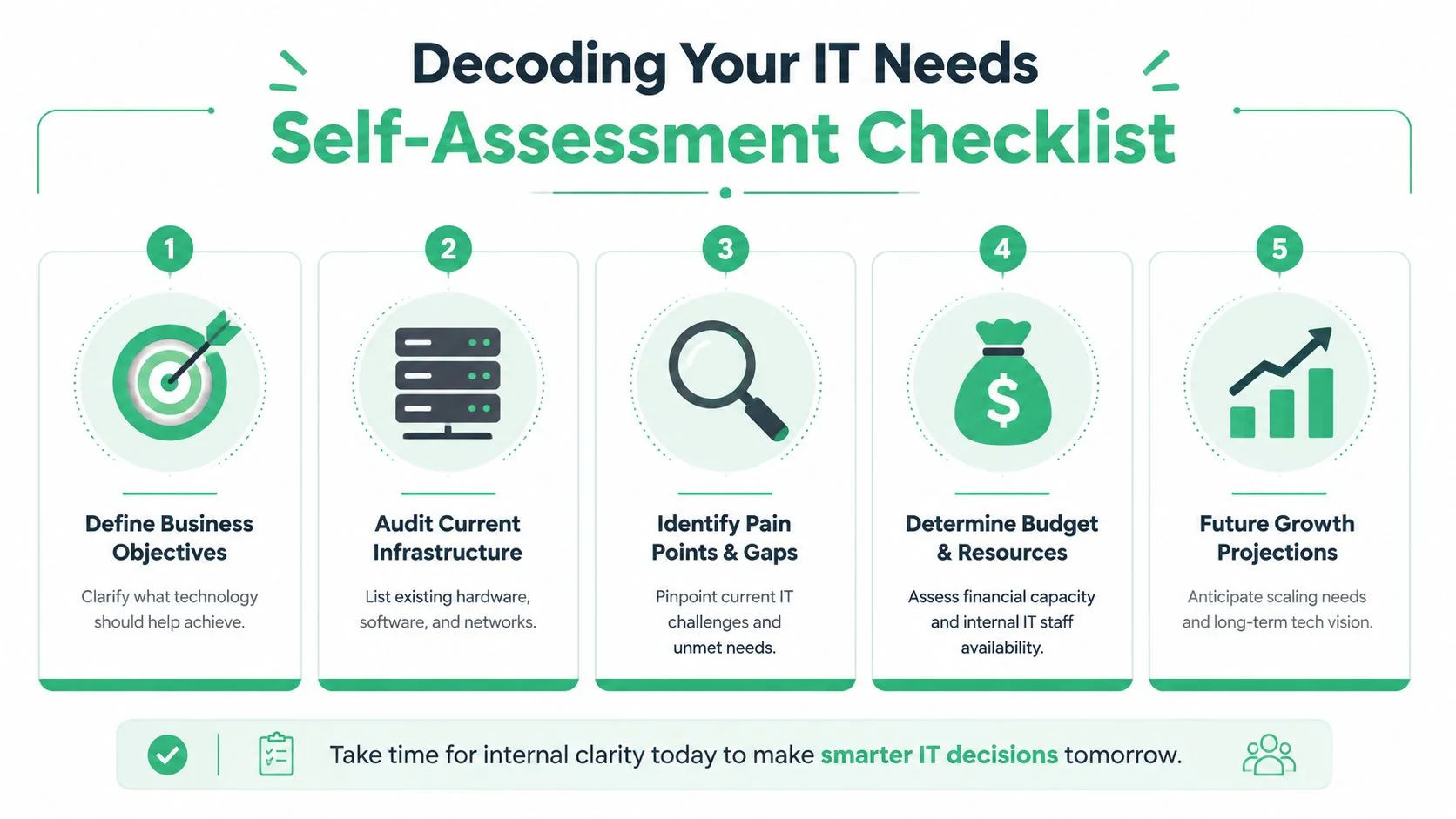
Sort the need before you sort the vendor
The first question isn't “who should we hire”. It's “what type of help do we need”.
A few common categories:
- Managed support need. You need ongoing helpdesk, device support, patching, backups, and user administration.
- Project need. You need a migration, office relocation, network refresh, Microsoft 365 uplift, or application rollout.
- Strategic need. You need somebody to make decisions about architecture, roadmap, vendor selection, and sequencing.
- Security and compliance need. You need hardening, policy work, access review, backup validation, and remediation of obvious control gaps.
These are not the same purchase. A firm that's good at responsive support may not be strong at strategic planning. A strategy-led consultant may produce good advice but leave you with no implementation muscle.
Melbourne's startup and creative sectors make this especially visible. In Melbourne's startup ecosystem, which includes over 1,200 firms, 65% of sole traders and small creative businesses operate without dedicated IT leadership, according to Azra's Melbourne IT consulting page. That's why fractional CTO support can be a better fit than buying a full managed service stack too early.
Ask operational questions, not technical ones
Before speaking to any provider, document the answers to these:
Where does work slow down today
Look at approvals, file access, reporting, onboarding, remote work, and customer response time.Which systems would hurt most if they stopped
Think about your accounting platform, line-of-business apps, phones, shared files, email, and internet dependency.What knowledge sits with one person
That's often your biggest hidden risk. It might be a staff member, a contractor, or the owner.What are clients, insurers, or larger customers starting to ask for
Security questionnaires and compliance obligations often arrive before businesses are ready for them.What must the business look like in two to three years
More sites, more staff, acquisitions, remote teams, higher client expectations, and stronger audit requirements all change what “good enough” looks like.
The best brief is short, commercial, and specific. “We need secure remote access for a growing hybrid team and a staged plan to clean up Microsoft 365 permissions” is far more useful than “we need better cybersecurity”.
Build a simple internal brief
Keep it to one or two pages. Include:
- Business context. Industry, team size, locations, and critical workflows.
- Current environment. Core applications, devices, internet setup, cloud platforms, backups, and support model.
- Pain points. Downtime, poor visibility, risky access, manual workarounds, compliance pressure.
- Desired outcomes. Faster onboarding, fewer outages, cleaner permissions, documented processes, reduced vendor sprawl.
- Constraints. Budget, timing, internal resources, existing vendor contracts, and operational blackout periods.
That brief gives consultants something real to respond to. It also protects you from buying a fashionable solution to the wrong problem.
How to Vet Melbourne IT Consulting Firms
A polished website tells you almost nothing about delivery quality. The same goes for broad service menus and generic client logos.
The biggest mistake I see is buyers treating vendor selection like a branding exercise. For Melbourne SMBs, the harder question is whether a consultant can reduce actual operating risk, especially around security controls that are easy to postpone and expensive to ignore.

Look past reviews and ask for evidence
Reviews have some value, but they rarely tell you whether a firm can handle your environment, your risk profile, or your pace.
Ask for evidence in three forms:
- Relevant case studies. Same industry is helpful, but similar complexity matters more.
- Named technologies. If they mention Microsoft 365, Azure, Cisco, Sophos, Veeam, or specific line-of-business platforms, ask how they use them in practice.
- Reference conversations. Speak to a current client with similar operational pressures.
A useful vetting shortcut is this guide on choosing a managed IT services provider, especially if you're comparing consulting-led firms with ongoing support providers.
Then test for depth. Don't ask, “Do you do cybersecurity?” Ask, “How would you phase access control, device hardening, backup review, and user awareness training in a business with limited internal IT capacity?” Good firms answer in sequence. Weak firms answer in slogans.
Use Essential Eight as a screening tool
For Melbourne SMBs, Essential Eight should be part of the buying conversation from the start.
A critical compliance gap exists for small firms because 78% of Australian SMBs lack a clear roadmap for implementing the Essential Eight controls, and SMEs face 40% higher breach rates than larger companies, according to Telco ICT's Melbourne IT consulting roundup citing ACSC 2025 data.
That matters because many consultants still treat SMB security as a bundle of tools rather than a control program. Antivirus alone won't fix weak admin access, poor patch discipline, uncontrolled applications, or missing recovery planning.
Ask direct questions such as:
- Which Essential Eight controls do you usually tackle first for SMBs
- How do you phase remediation when budget is tight
- What can you implement yourselves versus only advise on
- How do you handle Microsoft-aligned hardening in smaller environments
- What evidence will we have at the end of each phase
If they can't turn Essential Eight into a staged, affordable plan, they may not be the right fit for an SMB environment.
Here's a useful explainer to prompt the right sort of questions during vendor interviews:
Interview for delivery, not presentation
The strongest consultants usually sound calmer, not flashier. They talk about dependencies, access, user impact, documentation, rollback, and handover.
Use final interviews to pin down specifics:
| Question | What a good answer sounds like | Warning sign |
|---|---|---|
| Who actually does the work | Named roles and responsibilities | “Our team handles that” |
| How do you start | Discovery, audit, priorities, staged delivery | Immediate tool recommendation |
| What happens if you find bigger issues | Escalation path and change control | Vague reassurance |
| How do you document the environment | Shared documentation and ownership | Documentation only on request |
| What support exists after the project | Defined handover or managed support option | Project ends with no continuity |
If the consultant only sells advisory and can't point to implementation capability, expect a gap between strategy and results.
Comparing IT Services and Pricing Models
A Melbourne business usually feels the cost of a bad pricing model before it sees the technical problem. The invoice keeps growing, the scope stays fuzzy, and security work gets postponed because nobody is sure what sits inside monthly support and what counts as a project.
That matters most with security and compliance work. Essential Eight uplift is rarely a single job. Application control, patching, MFA, restricted admin access, backup protection, and user hardening often cut across projects, support, licensing, and staff training. If your consultant cannot separate those costs clearly, you will struggle to budget and you will struggle to prove progress.
Common engagement models
| Model | Best For | Pros | Cons |
|---|---|---|---|
| Project-based fee | Defined outcomes such as migrations, audits, rollouts, relocations, or an Essential Eight remediation phase | Clear scope, easier budgeting, milestone tracking | Change requests grow quickly if the environment is poorly documented |
| Monthly retainer | Ongoing support, vCIO or fractional CTO input, recurring security oversight, policy reviews | Predictable cadence, continuity, regular review points | Becomes passive if roles, reporting, and review dates are vague |
| Hourly consulting | Short-term troubleshooting, specialist reviews, urgent advice, second opinions | Flexible, quick to start, useful for niche expertise | Spend is hard to forecast and work can drift without tight control |
| Hybrid model | Businesses needing strategy plus delivery, or support plus a staged security program | Better alignment between roadmap, implementation, and support | Needs tighter contract wording so responsibility does not get blurred |
For many SMBs, a critical commercial risk is splitting advice from delivery. One firm writes the strategy. Another inherits the mess, disputes the assumptions, and charges again to rediscover the environment. I have seen this happen with Microsoft 365 hardening, backup redesign, and access reviews. It is expensive, slow, and hard to govern.
Providers that can advise, implement, and support are usually easier to hold accountable. That does not mean one supplier must do every task. It means the handoffs, acceptance criteria, and commercial boundaries need to be explicit.
What good commercial scope looks like
A strong quote makes it easy to see what you are buying and what could trigger extra cost.
Check whether the proposal separates these items clearly:
- Discovery work. Audit, workshops, documentation review, stakeholder interviews, and a current-state risk summary.
- Remediation or build work. The actual implementation, not just a slide deck of recommendations.
- Security and compliance mapping. Which parts of the work support Essential Eight, insurer requirements, or audit obligations.
- Licensing and third-party costs. These should never be buried inside labour.
- Ongoing support. Distinct from project fees, with defined inclusions and response expectations.
- Assumptions and exclusions. The section that often decides whether a fixed fee stays fixed.
The overlooked issue is evidence. If a consultant says they are improving your security position, the quote should say what proof you receive. That might be a patching report, conditional access policy list, privileged access review, backup test result, or an Essential Eight maturity summary. Without that evidence, you are paying for activity, not an outcome.
If the project touches ERP, CRM, finance workflow, or integrated operations, it helps to understand how the software layer will interact with your infrastructure and support model. Businesses reviewing unified operations often compare infrastructure advice with platforms such as Odoo all-in-one business software to work out whether the core issue is fragmented process design rather than aging IT alone.
For monthly support, pricing should also show what happens outside the base service. Security incidents, after-hours changes, onboarding new users, major vendor escalations, and compliance reporting are common points of dispute. A practical benchmark like this managed IT services pricing calculator guide helps clarify what should sit inside recurring support and what should be quoted separately.
Ask one final commercial question. What does the provider expect your environment to look like after 90 days, and how will they prove it? If the answer is vague, the pricing model probably is too.
Running a Smart Procurement and Onboarding Process
A messy buying process usually creates a messy onboarding process.
That sounds obvious, but many SMBs still buy IT consulting through informal chats, broad quotes, and rushed decisions after an incident. The market has matured well beyond that. The Australian management consulting market is valued at USD 9.43 billion in 2026, with digital transformation the fastest-growing segment according to Mordor Intelligence's Australia management consulting market analysis. Buyers should expect proper proposals, structured procurement, and formal service levels.
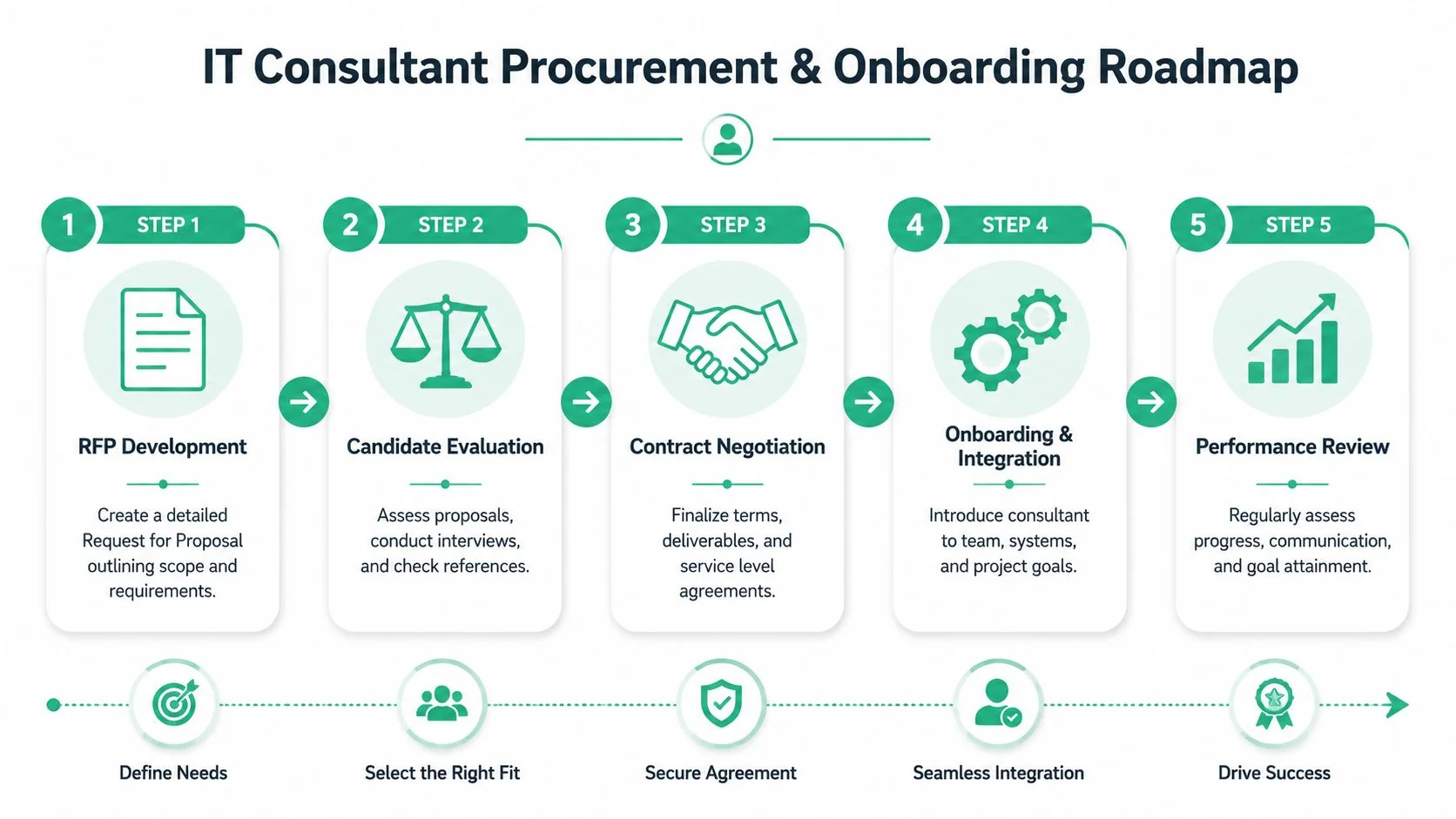
What to put in your brief
Your request for proposal doesn't need corporate theatre. It does need enough detail for firms to price and respond properly.
Include these elements:
Business summary
Industry, number of users, locations, critical systems, and internal owner.Required services
Spell out whether you need strategy, project delivery, support, security uplift, or some combination.Current issues
Downtime, support gaps, undocumented systems, access concerns, aging hardware, compliance pressure.Success criteria
Better resilience, faster support, cleaner identity controls, improved visibility, reduced manual work.Response format
Ask vendors to separate discovery, implementation, timeline, assumptions, ongoing support, and exclusions.
A good RFP also asks who will do the work, how escalation works, and what documentation you'll receive.
Buyers often focus on price too early. The stronger move is to compare delivery model, scope discipline, and ownership first, then price.
What onboarding should look like
Once you select a partner, the first few weeks matter more than the sales process.
A competent onboarding plan should include:
- Access and credential handover. Admin accounts, tenant access, ISP details, backup systems, licence portals.
- Environment discovery. Validation of what's in place, not what people think is in place.
- Risk register. Immediate issues found during onboarding, prioritised by business impact.
- Support pathways. Who logs issues, who approves changes, and who signs off on key decisions.
- Communication rhythm. Weekly check-ins early on, then a steady review cadence.
What you don't want is a provider who starts billing support before they understand your environment. That usually leads to reactive work, repeated questions, and missed dependencies.
A well-run onboarding is quiet. Staff know where to go for help. Leadership gets a concise view of risks and priorities. The new provider documents the environment as they go, rather than treating documentation as optional admin.
Your Final Decision Checklist
Final selection usually comes down to risk, not features.
For Melbourne SMBs, the missed question is often security governance. A firm can sound polished in workshops and still leave you exposed on patching, admin privileges, backups, logging, and MFA enforcement. If your business handles client data, payment information, health records, legal files, or sensitive commercial documents, that gap becomes expensive fast.
Use this final check. If a provider is weak in any one area, expect more rework, more internal effort, and more avoidable risk later.
Strategic alignment
A good firm should understand how your business makes money, where downtime hurts, and which systems matter to operations.
Look for practical signs:
- They connect IT priorities to revenue, compliance, and service delivery
- They understand your industry constraints, such as privacy obligations, site access limits, or legacy line-of-business systems
- They can stage work around trading hours, warehouse activity, clinical schedules, or finance deadlines
- They push back on low-value requests and explain the trade-off clearly
If the conversation stays at the product level, they are still selling, not advising.
Proven capability
Past delivery matters more than polished presentations. A key test is whether the firm can show how it reduces operational risk and gets work into production without creating new problems.
Ask for evidence in areas many SMBs skip over:
- Examples of Essential Eight uplift work, not just general cyber projects
- A clear method for patching operating systems, applications, and internet-facing systems
- Their approach to restricting administrative privileges
- How they handle MFA, backup testing, logging, and incident response preparation
- Proof they can document controls well enough for audits, insurers, or board reporting
Weak providers get exposed. Some can recommend improvements, but struggle to implement them across Microsoft 365, endpoints, servers, firewalls, and user processes in a controlled way.
A security roadmap is only useful if the provider can turn it into working controls your team can maintain.
Also check whether the people pitching the work are the people who will directly deliver it. That matters in security and compliance projects, where shortcuts during implementation usually surface months later.
Commercial value
Price still matters. It just should not be the first filter.
A commercially sound choice usually looks like this:
- Scope is specific, including what is and is not covered
- Project fees, recurring support fees, and third-party licensing are separated clearly
- Security and compliance tasks are priced visibly, rather than buried inside vague support wording
- Response targets, escalation paths, and remediation responsibilities are defined
- The contract does not leave major controls as optional extras after signing
- The delivery plan respects your staff capacity and approval process
One final test helps here. Ask each finalist what they would fix in the first 90 days if they found gaps against the Essential Eight. The stronger provider will give you a prioritised answer with business impact, dependencies, likely disruption, and what can wait. The weaker one will stay generic or jump straight to tools.
Choose the firm that reduces risk in a way your business can absorb. That is usually the better commercial decision, even if the headline price is not the lowest.
Frequently Asked Questions
Should you choose a Melbourne firm or can an interstate consultant work
Either can work. The deciding factors are responsiveness, clarity, and whether you need regular on-site presence.
A local Melbourne provider may suit businesses with physical infrastructure, warehouses, specialist equipment, or offices where hands-on support matters. An interstate firm can still be a good option if most systems are cloud-based and the support model is mature. Ask exactly how on-site visits are handled, who pays for them, and what issues are considered remote versus on-site.
What contract red flags should SMBs watch for
Look carefully at lock-in periods, vague service descriptions, broad exclusions, and unclear ownership of documentation. Watch for language that makes everything “best effort” without defining response times or escalation paths.
Also check who owns tenant access, admin credentials, and core documentation if the relationship ends. You should never be in a position where changing provider becomes a recovery project.
What's the difference between an IT consultant and a managed services provider
An IT consultant is usually engaged for strategy, projects, architecture decisions, reviews, or specialised remediation. A managed services provider typically handles recurring operational support such as user support, monitoring, patching, backup checks, and everyday administration.
Some firms do both. That can be useful, but only if they're clear about where consulting ends and support begins. If everything is bundled into one vague monthly fee, accountability gets blurry fast.
When does a business need fractional CTO support
Usually when the business is growing faster than its decision-making discipline. You may not need a full-time IT leader, but you do need someone who can set priorities, manage vendors, review proposals, and make sure technology decisions support the business plan.
This is common in professional services, agencies, creative firms, and growing multi-site businesses where the owner or operations manager has been carrying technology decisions by default.
What should happen in the first month after signing
You should see access handover, environment discovery, a prioritised issues list, support contacts, and a plan for immediate risks. If the new provider spends the first month asking basic questions without building documentation or identifying priorities, onboarding is too loose.
If you're looking for a practical technology partner rather than another vague proposal, Bridge IT Solutions is worth a look. They support small and medium organisations with managed IT, cybersecurity, cloud services, and business-focused advice, with an emphasis on clear service levels, proactive support, and solutions that are realistic for everyday operations.
