

You're probably already doing the basics. Antivirus is installed. Staff use Microsoft 365. Files are in the cloud. Backups exist, at least in some form. On paper, that can look “secure enough”.
Then you hear that another Brisbane business lost access to its files, spent days untangling accounts, or had to explain a data incident to clients. That's usually the point where cybersecurity stops feeling abstract. It becomes a business question about downtime, trust, and whether your current setup would hold up under pressure.
For small and medium businesses, a computer security consultant isn't there to sell fear. The role is to turn vague technical risk into practical decisions you can budget for, prioritise, and manage without pulling your team away from their actual jobs.
Table of Contents
- Why Your Business Needs More Than Just Antivirus
- What a Computer Security Consultant Actually Does
- Calculating the Real ROI of Security Consulting
- Hiring the Right Consultant in Brisbane
- Your Hiring Checklist 10 Questions to Ask
- Local Examples of Security Consulting in Action
- Your Next Step Towards a Resilient Business
Why Your Business Needs More Than Just Antivirus
Antivirus still matters. It's one layer. The problem is that most attacks against SMBs don't arrive as a simple virus that one product neatly catches and removes.
They come through everyday business activity. A fake Microsoft 365 sign-in page. A staff member approving the wrong prompt on their phone. An inbox rule forwarding mail outside the business. A supplier invoice that looks legitimate enough to get opened. By the time antivirus has a chance to help, damage may already involve accounts, email, cloud files, and business process disruption.
That's why a computer security consultant looks at the whole operating environment, not just the endpoint. Email security, identity controls, backup integrity, remote access, user permissions, patching discipline, staff behaviour, and incident response all need to work together.
Australia's broader market tells the same story. The Australian cybersecurity market is projected to reach USD 9,137.2 million by 2033, driven by a shortage of tens of thousands of skilled cyber-security professionals, which is one reason experienced guidance is harder to replace with off-the-shelf tools alone, according to Grand View Research's Australia cyber security market outlook.
The real gap is strategy, not software
Most Brisbane businesses we speak with don't have no security. They have fragmented security. One person manages Microsoft 365. Another looks after the firewall. Someone else set up backups years ago. Nobody has tested how those pieces hold together during an actual incident.
That's where external advice earns its keep. A consultant can translate frameworks into actions that fit a smaller business, especially around essentials such as multi-factor authentication, access reviews, backup recovery, and the Essential Eight guidance for Australian businesses.
Practical rule: If your protection depends on one staff member “just knowing how it all works”, you don't yet have a resilient security posture.
What basic protection misses
A lot of owners assume “we've got antivirus” means “we've covered cybersecurity”. Usually, it means only one category of threat has some level of attention.
Common blind spots include:
- Email and identity exposure that lets attackers log in without ever deploying obvious malware.
- Over-permissioned staff accounts that give too many people access to shared folders, finance tools, or admin settings.
- Untested backups that exist on paper but haven't been restored under realistic conditions.
- No incident plan so the first hour of a breach turns into confusion, delay, and expensive guesswork.
A consultant's value is that they reduce uncertainty. For a non-technical owner, that matters as much as any tool. You need to know what would likely happen if something went wrong on a Tuesday morning, who would do what, and how quickly operations could continue.
What a Computer Security Consultant Actually Does
The easiest way to understand a computer security consultant is to think about your premises.
If you owned a warehouse or office, you wouldn't call security “done” because there's a lock on the front door. You'd care about keys, alarms, cameras, who can enter after hours, what happens if there's a break-in, and whether staff know the process. Digital security works the same way. The consultant helps design the system, test it, tighten it, and make sure people can follow it.
Security starts with finding weak spots
A proper engagement usually begins with assessment. That may include reviewing Microsoft 365 settings, checking conditional access and multi-factor authentication, inspecting backup coverage, examining remote access paths, and looking at how devices are patched and managed.
Technical work often goes beyond review. A consultant may perform ethical hacking and penetration testing to uncover weaknesses, then build an action list in order of business risk, as described by ISO 27001 Australia's overview of cyber security consultant responsibilities. If you want a practical example of what that assessment layer can look like, a vulnerability assessment service for SMB environments is often where hidden issues first become visible.
That matters because SMBs rarely fail due to one dramatic flaw. They get caught by combinations of smaller ones. A stale admin account. No geo-blocking. Weak mailbox controls. Shared credentials. Backups that don't cover cloud data properly.
Here's the work in plain English:
- They assess risk by identifying where your systems, users, and processes are exposed.
- They improve controls by hardening Microsoft 365, tightening admin access, and reducing unnecessary permissions.
- They test assumptions by checking whether your current safeguards would stop or slow a common attack.
- They prepare for incidents so staff know who isolates devices, who contacts clients, and who restores services.
Protection only works if people can use it
Good consultants don't just hand over a report. They turn the findings into a workable roadmap for your business.
That can include staff awareness training, phishing simulations, secure device policies, clearer onboarding and offboarding, documented escalation paths, and business continuity measures for critical systems. The same ISO 27001 Australia source notes that consultants also develop incident response plans to minimise breach damage and deliver security awareness training to reduce phishing and social engineering risk.
The strongest technical control in the world won't help if staff bypass it because it slows down normal work.
Effective security relies on experience. Security that's too rigid gets ignored. Security that's too loose becomes theatre. The useful middle ground is controls that match the way your team works.
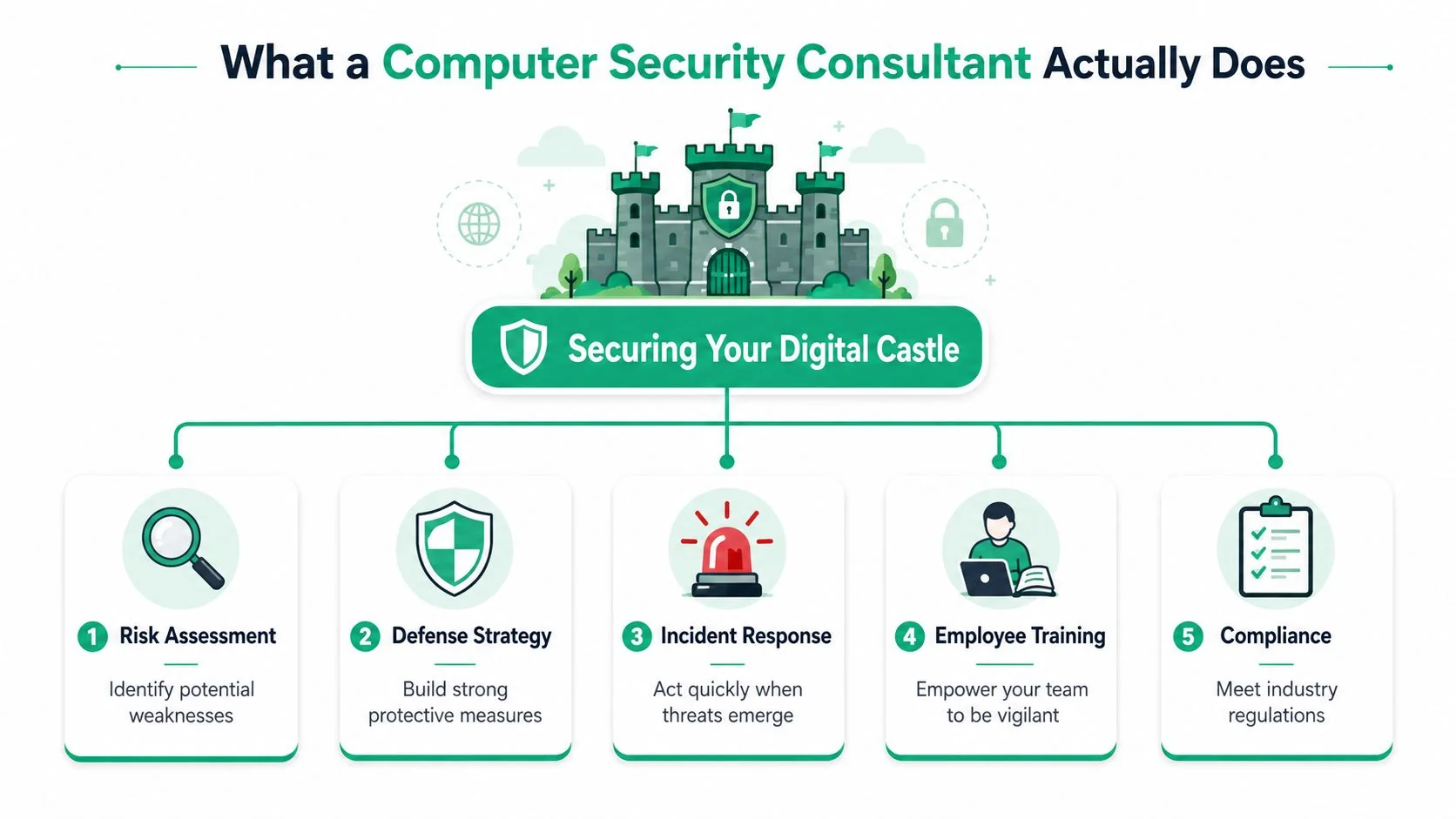
A practical consultant will usually help across five areas:
Risk review
What could interrupt operations, expose client data, or create legal headaches?System hardening
Microsoft 365, endpoints, Wi-Fi, firewalls, and remote access all need baseline discipline.User training
Staff need short, repeatable habits, not technical lectures.Incident readiness
If a mailbox is compromised or a device is encrypted, the response should already be documented.Compliance alignment
If you handle sensitive information, your controls should support the obligations that apply to your sector.
For Brisbane SMBs, that's the difference between “we have some security products” and “we know how our business would keep functioning during a cyber event”.
Calculating the Real ROI of Security Consulting
Most owners don't struggle with the idea that security matters. They struggle with the invoice.
That's fair. Security spending can feel intangible when nothing bad has happened yet. The problem is that many businesses compare a consultant's fee to zero, when the proper comparison should be against the cost of disruption, recovery, and lost time after an incident.
The cost you can plan for versus the cost you can't
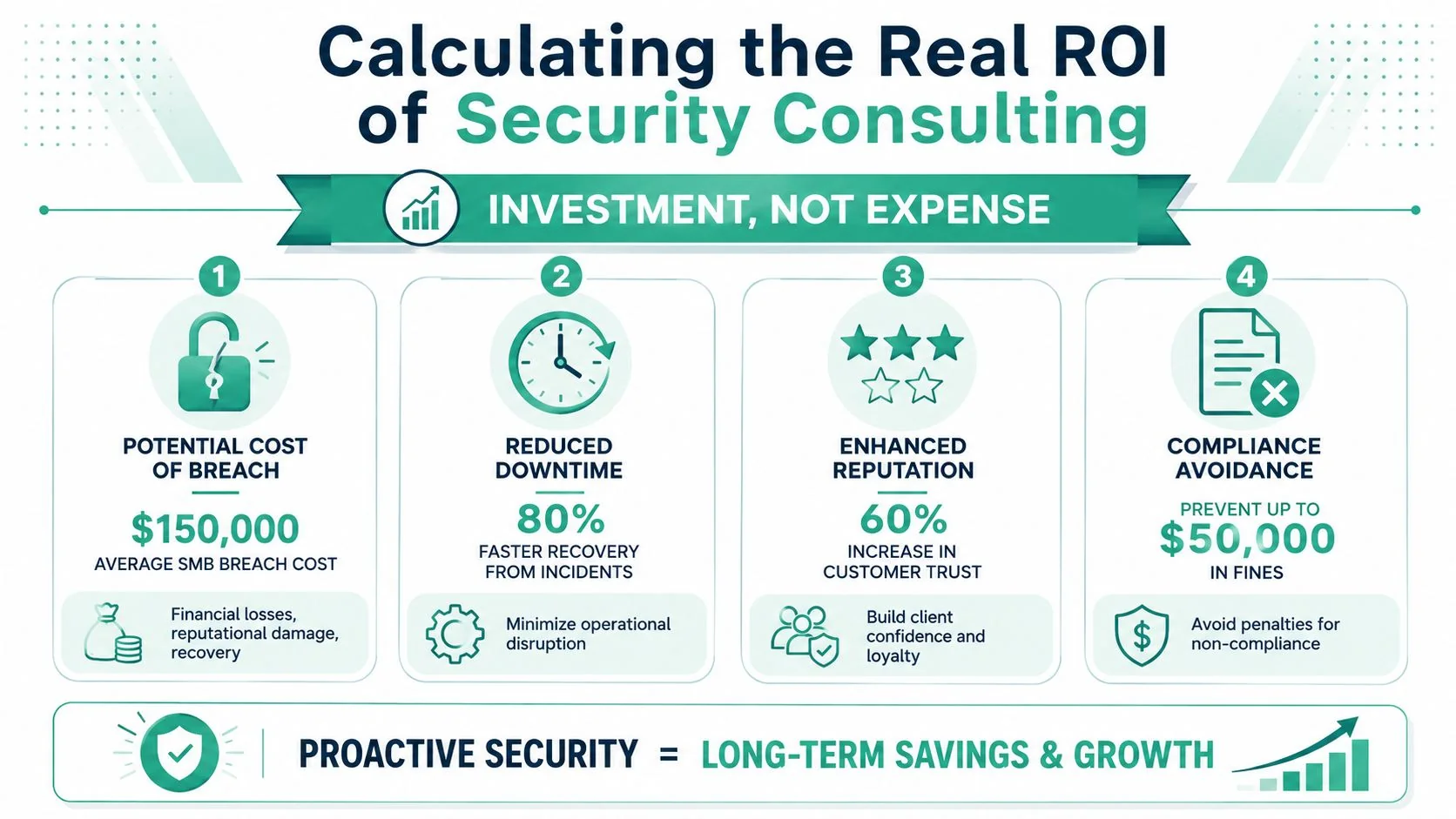
Australia's IT Security Consulting industry includes 6,168 firms and grew at a 3.4% CAGR from 2020 to 2025, yet many SMEs still struggle to connect consulting fees to business outcomes. One practical benchmark is ransomware recovery, which averages $15,000–$20,000 for small Australian businesses, based on IBISWorld's Australia IT Security Consulting industry data.
That number matters because it gives owners a more grounded way to think about return. A consultant's work isn't just about prevention in the abstract. It's about reducing the likelihood, spread, and operational cost of exactly that kind of event.
There are also softer costs that owners feel immediately even when they don't appear in the first invoice:
- Interrupted billing when staff can't access systems or issue invoices
- Lost labour time while your team works around locked files or account issues
- Client confidence damage when communication slows or sensitive information is questioned
- Management distraction because leadership gets pulled into technical triage instead of running the business
A simple way to think about return
For an SMB, ROI usually becomes clear when the consultant helps you answer three questions:
| Cost area | What to ask |
|---|---|
| Recovery expense | If key files or systems were unavailable tomorrow, what would recovery actually involve? |
| Downtime impact | Which teams stop work first, and what does that interruption do to service delivery or cash flow? |
| Control maturity | Which practical fixes would reduce the chance or severity of a common incident? |
A useful security engagement creates visible business outputs. Fewer admin accounts. Better mailbox protection. Tested restore procedures. Staff who report suspicious emails faster. Cleaner offboarding. Documented incident steps. Those aren't vanity items. They lower the cost of mistakes.
Spend should follow consequence. The systems that would hurt most if they failed deserve attention first.
That's why the best ROI conversations aren't about buying every control at once. They're about sequence. Lock down the highest-risk areas first. Test recovery. Reduce easy paths in. Train staff on the attacks they encounter. For a Brisbane SMB, that's usually where cybersecurity stops looking like overhead and starts looking like disciplined risk management.
Hiring the Right Consultant in Brisbane
Not every IT provider is a computer security consultant, and not every security consultant is the right fit for a Brisbane SMB.
Some firms are strong at enterprise advisory work but too removed from day-to-day small business operations. Others can install tools but can't explain Australian compliance obligations in plain language. You want someone who can do both. They should understand the local business environment, communicate clearly with non-technical staff, and know how to prioritise within a real-world budget.

What qualifications actually matter
For Australian businesses, local regulatory understanding isn't optional. A capable consultant needs familiarity with the OAIC notification timeline, the Essential Eight, and sector-specific obligations such as APRA CPS 234 for financial services or PCI DSS for payment security. Advanced certifications such as CISSP, CISM, or ISO 27001 Lead Auditor are strong indicators that the consultant has been tested on broader security governance and control design, as outlined in Interactive's guide to evaluating cyber security consulting services.
Certifications aren't everything, but they do help you separate informed advice from recycled sales talk.
Look for evidence in three categories:
Regulatory fluency
They should explain your obligations in business language, not just name-drop frameworks.Technical depth
They need to be comfortable discussing identity security, cloud controls, backups, logging, and incident workflows.Operational fit
They should propose actions your team can maintain after the project ends.
If you're also considering ongoing monitoring and response after the initial advisory work, a managed detection and response approach for SMBs can help you assess whether the consultant is thinking beyond the first report.
What realistic pricing tells you
The Australian market gives a useful benchmark. An experienced computer security consultant can command a daily rate of around $1,040, with average annual salaries at $160,000, according to Clicks IT Recruitment salary data for security consultants. That doesn't tell you what your exact engagement will cost, but it does explain why experienced security advice isn't priced like general desktop support.
The key trade-off is this:
| Option | What you often get | What to watch for |
|---|---|---|
| Cheap generic provider | Basic checklists and broad recommendations | Little tailoring to your systems or risk profile |
| Technical specialist with poor communication | Deep knowledge, weak stakeholder buy-in | Staff may ignore or misunderstand changes |
| Practical local partner | Prioritised actions, clearer support, business context | Scope must still be defined carefully |
One example in this category is Bridge IT Solutions, which includes Microsoft 365 security hardening, network security, simulated phishing, malware and cryptolocker remediation, backup, and business continuity as part of broader managed IT support for South East Queensland organisations.
Ask whether the consultant's recommendations are meant to be lived with for the next year, or just presented once and forgotten.
That one question exposes a lot. The right consultant leaves you with a system your business can operate, not a document your business files away.
Your Hiring Checklist 10 Questions to Ask
A good meeting with a computer security consultant shouldn't feel like a product demo. It should feel like risk discovery.
The easiest way to keep that conversation honest is to ask questions that force specifics. If the answers stay vague, overly generic, or heavily product-led, that's usually a warning sign. You want to hear how they assess, prioritise, communicate, and support.
Consultant Vetting Checklist
| Question Category | Question to Ask |
|---|---|
| Business Risk | How do you identify which systems and processes matter most to our business operations? |
| Australian Compliance | How would you help us meet the Australian obligations that apply to our industry and client data? |
| Microsoft 365 Security | What would you review first in our Microsoft 365 environment, and why? |
| Access Control | How do you approach admin accounts, user permissions, and staff offboarding? |
| Incident Response | If we had a compromised mailbox or ransomware event, what would your first steps be? |
| Backups and Recovery | How do you verify that backups can actually be restored when the pressure is on? |
| Staff Training | What kind of phishing or awareness training do you recommend for a small team with limited time? |
| Prioritisation | If our budget is limited, which security improvements would you tackle first? |
| Reporting | How will you show us what changed, what risks remain, and what needs attention next? |
| Ongoing Support | After the initial project, what does ongoing review, monitoring, or advice look like? |
A few answers deserve extra scrutiny.
If they can't explain trade-offs, they probably don't work with SMBs often. Smaller businesses need sequencing. They need to know what should happen now, what can wait, and what isn't worth the disruption.
If every answer leads straight to a tool, they may be selling products before they understand your environment. Tools matter, but a weak process wrapped around a good product still creates exposure.
Good consultants answer in priorities, not slogans.
Take notes on clarity, not just confidence. The strongest candidate usually isn't the one using the most jargon. It's the one who can explain a realistic path from your current state to a safer, more resilient setup without pretending every business needs enterprise-level complexity.
Local Examples of Security Consulting in Action
Abstract advice only goes so far. The value of a computer security consultant becomes clearer when you look at the kinds of problems Brisbane businesses face.

A professional services firm that needed cleaner controls
A small professional services firm had grown quickly and inherited a messy Microsoft 365 setup. Former staff accounts still existed. Shared mailboxes had broad access. Multi-factor authentication was inconsistent, and leadership wasn't confident about who could access sensitive client documents.
The first step wasn't buying new tools. It was cleaning up identity, access, and process. Admin privileges were reduced, dormant accounts were removed, authentication settings were tightened, and document access was reviewed against actual roles. Staff also received short training focused on invoice fraud and account compromise, because those risks matched how the business operated.
The outcome wasn't dramatic from the outside. That's usually a good sign. Daily work continued, but with fewer hidden exposures and a much clearer understanding of who had access to what.
A field-based business that couldn't afford interruption
A trades business relied on shared files, mobile devices, and a small office team coordinating jobs, invoices, and supplier communication. The owner's main concern wasn't compliance language. It was simple: if systems went down, crews would lose time and cash flow would tighten fast.
Security consulting focused on continuity. Backups were reviewed, restore procedures were documented, remote access was tightened, and the business put clearer steps in place for suspicious emails and device issues. The goal was to reduce the chance that one compromised account or infected device could spread chaos across the operation.
That's the practical side of cybersecurity for SMBs. It isn't about turning a trades company into a bank. It's about making sure one bad click doesn't derail payroll, scheduling, client communication, and invoicing for days.
Your Next Step Towards a Resilient Business
A Brisbane business owner usually asks the same practical question at this point. What will this cost me, and what does it save me?
That is the right question. Cybersecurity earns its place in an SMB budget when it prevents a far more expensive problem. If ransomware locks your files, recovery can cost $15,000 to $20,000 before you count lost trading time, delayed invoices, staff disruption, and the hit to customer confidence. A good consultant helps reduce the chance of that bill landing on your desk, and helps limit the damage if something still gets through.
For a local business, the value is rarely in buying more tools. It is in deciding what matters first. Which system would stop sales or service delivery if it went offline? Which account could expose client data? Which gap can wait a quarter, and which one needs attention this month? That prioritisation is what turns cybersecurity from a technical topic into a business decision.
I see the best results when owners treat security work the same way they treat insurance, maintenance, or cash flow planning. The goal is not perfection. The goal is fewer avoidable losses, faster recovery, and less operational stress when something goes wrong.
If your setup has grown in pieces over time, that is common. The next step is a clear plan. Start with the risks that would cost the most, assign practical actions, and choose protections your team can maintain without adding unnecessary complexity.
If you want a grounded view of where your risks sit today, contact Bridge IT Solutions for a complimentary, no-obligation security assessment. We'll identify the gaps that matter to your business, explain the trade-offs in plain English, and outline sensible next steps for a safer, more resilient operation.
